
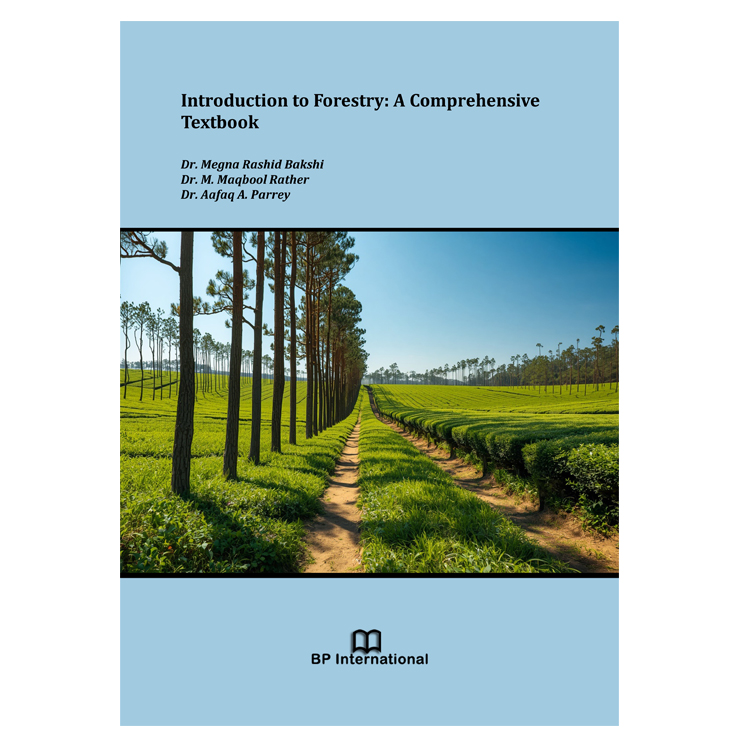
Introduction to Forestry: A Comprehensive Text Book has been prepared as a foundational text for undergraduate students of forestry, particularly first-year B.Sc. (Hons.) Forestry students. Its organisation follows the prescribed course sequence, beginning with the meaning, functions and benefits of forests and progressing through forest classification, Indian forest types, agroforestry, forest legislation, climate change, world forestry, forest economics, industries, trade, contemporary development trends and forestry organisations.
The principal aim of the book is to build a clear conceptual foundation before introducing wider ecological, economic, institutional and global dimensions of forestry. The early chapters explain essential terminology and classification systems. Chapters on Indian forest types connect climatic and ecological conditions with vegetation patterns and distribution. Subsequent chapters introduce agroforestry, social forestry and participatory forest management, followed by the legal and policy framework that shapes forestry practice in India.
Forestry cannot be understood only as the production of timber. Accordingly, the book gives substantial attention to ecosystem services, climate-change mitigation and adaptation, carbon sequestration, biodiversity, community participation and sustainable forest management. The world-forestry chapters broaden this perspective by comparing forest resources and management practices across major geographical regions. Later chapters examine forest-development problems, forest-based industries, international raw-material trade, technological and institutional change, and the organisations that support forestry at national and international levels.
Students are encouraged to use the book progressively rather than treating individual chapters as isolated topics. Important concepts introduced early, such as forest classification, sustainable forest management, productivity, increment and ecosystem services, reappear in later discussions of climate change, economics, industries and international forestry.
Each chapter begins with clearly stated learning objectives. Students should read these objectives before studying the chapter and return to them after completing it. Definitions, examples, comparisons and tables are intended to support conceptual understanding rather than memorisation alone. Chapter summaries provide rapid revision, while key terms reinforce essential vocabulary. The review questions include objective, short-answer, descriptive and applied questions and can be used for self-assessment, classroom discussion and examination preparation.
The book is therefore designed both as a course text and as an introductory reference. Readers who follow the chapters in sequence should develop an integrated understanding of forests as ecological systems, renewable resources, livelihood foundations, economic assets and institutions of major importance to society and environmental sustainability.