Coffee belongs to the genus Coffea L. of the Rubiaceae family and serves as a highly significant economic crop in subtropical and tropical regions. Among the world’s three major beverage crops (coffee, tea, and cocoa), coffee ranks first in terms of production, output value, and consumption. Its estimated annual retail value is approximately 70 billion U.S. dollars, making it a primary source of income for over 100 million people and crucial to the economies of more than 60 countries. In China, the main cultivated varieties are Coffea arabica (small-grain coffee) and C. canephora (medium-grain coffee). The former is primarily grown in high-altitude, low-latitude regions such as Yunnan, while the latter is mainly cultivated on Hainan Island, where conditions are characterized by high temperatures, high humidity, and altitudes below 600 meters. Small-grain coffee was first introduced to China in 1892 by French missionaries in Zhukula Village, Binchuan County, Yunnan, whereas medium-grain coffee was introduced to Hainan Island in the early 20th century. According to statistics, the global coffee industry reached a market size exceeding 400 billion U.S. dollars in 2022. In China, the coffee industry’s market scale reached approximately 145.4 billion yuan in 2022, representing a year-on-year increase of 28.6%. Although China’s coffee consumption market is less mature compared to North American and European countries such as the United States, Germany, and France, it possesses substantial growth potential and is currently in a phase of rapid development.
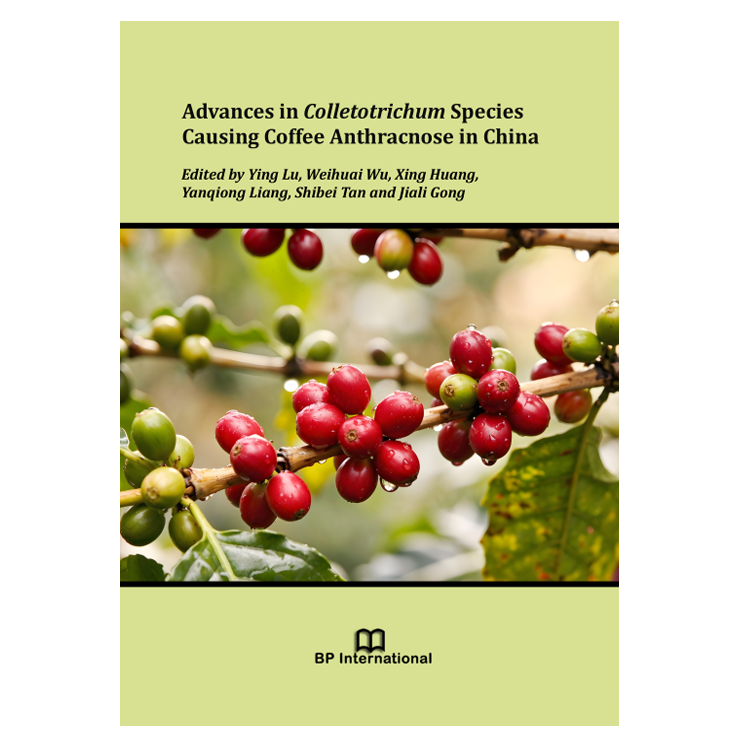
Advances in Colletotrichum Species Causing Coffee Anthracnose in China
Ying Lu
Environment and Plant Protection Institute, Chinese Academy of Tropical Agricultural Sciences, Haikou, China.
Weihuai Wu
Environment and Plant Protection Institute, Chinese Academy of Tropical Agricultural Sciences, Haikou, China.
Xing Huang
Environment and Plant Protection Institute, Chinese Academy of Tropical Agricultural Sciences, Haikou, China.
Yanqiong Liang
Environment and Plant Protection Institute, Chinese Academy of Tropical Agricultural Sciences, Haikou, China.
Shibei Tan
Environment and Plant Protection Institute, Chinese Academy of Tropical Agricultural Sciences, Haikou, China.
Jiali Gong
Xuzhou Institute of Agricultural Sciences in Jiangsu Xuhuai Area, Jiangsu, China.
Book Details
| Edited by | Ying Lu |
|---|---|
| Pages | 37 |
| Publisher | BP International |
| Language | English |
| ISBN-13 (15) | 978-93-47485-84-8 (Print) |
| Published | December 29, 2025 |