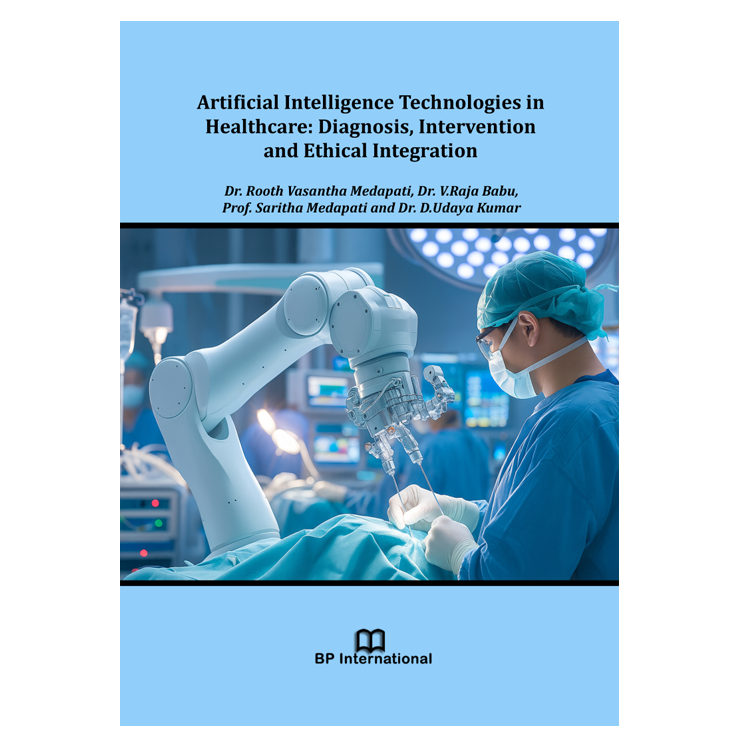
The advent of Artificial Intelligence (AI) represents one of the most transformative developments in modern science and technology. Its integration into the healthcare domain is revolutionising how diseases are diagnosed, monitored, and treated, enhancing clinical accuracy and operational efficiency. This academic work, “Artificial Intelligence Technologies for Healthcare Diagnosis and Intervention “, has been undertaken with the aim of exploring the breadth and depth of AI applications across various branches of medicine.
This text serves as a comprehensive resource for students, researchers, and practitioners in the fields of healthcare, biomedical engineering, computer science, and health informatics. It begins with a foundational overview of AI’s emergence in healthcare, tracing its historical roots and contextualising its current trajectory. The subsequent chapters delve into specific areas where AI is making significant strides, particularly in medical imaging, predictive analytics, personalised medicine, and surgical robotics.
Special attention is given to the technical underpinnings of AI, including the role of convolutional neural networks (CNNs) in image analysis, the utilisation of electronic health records (EHRs) for predictive modelling, and the convergence of genomics with machine learning for individualised treatment planning. The work also critically addresses ethical and regulatory challenges, such as data privacy, algorithmic fairness, and accountability, issues that must be navigated carefully to ensure safe and equitable AI integration.
Looking forward, the final chapters project the future of AI in medicine, highlighting promising directions such as explainable AI (XAI), federated learning, and human-AI collaboration. The goal is not only to document the current state of the field but also to inspire further inquiry and innovation, ensuring that AI technologies are harnessed responsibly for the benefit of patients and healthcare systems globally.
This compilation reflects interdisciplinary scholarship and practical insights, drawn from both peer-reviewed literature and real-world implementations. It is hoped that this work will contribute meaningfully to the ongoing dialogue on the ethical, scientific, and societal implications of AI in healthcare.